
How to Start a Lawn Care Business

You can buy a mower this weekend and have paying customers by the next weekend. That part is easy, and almost every guide on how to start a lawn care business walks you through it.
What catches people is everything else. Nobody tells you that a business license and an LLC are two different filings, that your state charges a real fee to register a company, or that some states bill you every year afterward whether you earned anything. This guide covers the legal and cost layer properly, with real numbers.
Here is the path: what you need, what it costs, whether you need an LLC, how to register, licenses and insurance, equipment, pricing, profitability, and what you owe yearly.
Key Takeaways
- Every State Charges a Fee to Register an LLC. Filing fees run from $35 in Montana to $500 in Massachusetts.
- A Local Business License and a State Entity Filing Are Different Things, with different issuers.
- Every State Requires a Separate License to Apply Pesticides, even where basic mowing needs none.
- A Low Filing Fee Does Not Mean a Cheap State to Stay In. California costs $70 to register, then $800 every year in franchise tax.
- Most Owners Start With Used or Borrowed Equipment and reinvest early earnings.
What Do You Need to Start a Lawn Care Business?
You need a mower, a trimmer and a blower, a business name, a legal structure, and liability insurance. Most cities also require a local business license, and every state requires a separate license to apply pesticides. You can start with borrowed equipment, but skipping the insurance is what ends businesses.
That is the whole list. No office, no truck, no employees, no website. Plenty of operators run for years out of a personal vehicle. What you need on day one is a decision about how the business is structured, because that decides who pays when something goes wrong.
How Much Does It Cost to Start a Lawn Care Business?
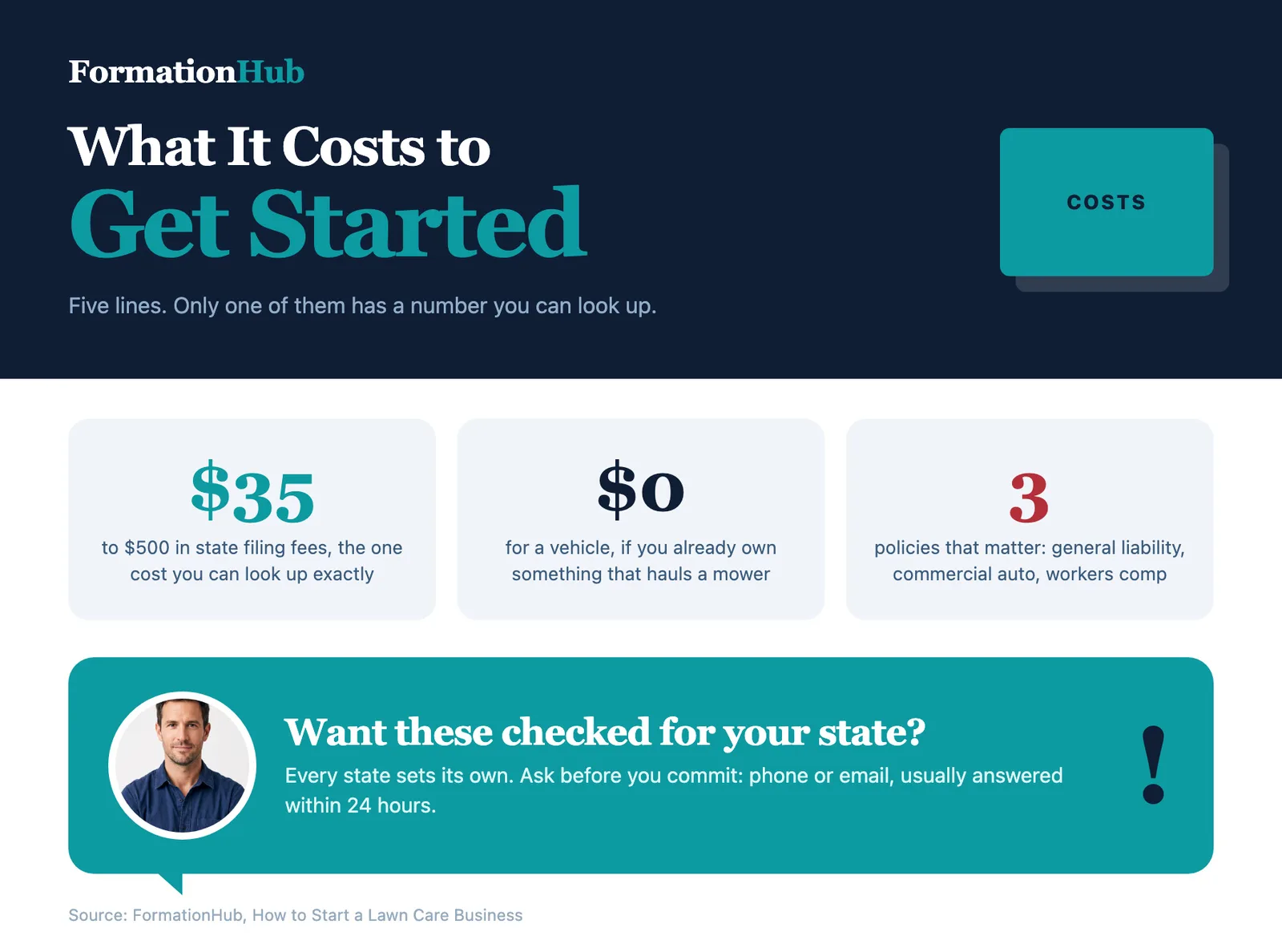
Estimates online range from a few hundred dollars to tens of thousands, and that gap is not confusion. It reflects two choices: whether you buy equipment new or used, and whether you buy a truck. State filing fees add $35 to $500 if you form an LLC. Most owners start small and reinvest.
Once you separate those variables, lawn care business startup costs stop looking mysterious:
- Equipment. The biggest swing. Used homeowner-grade gear versus new commercial equipment differs by thousands, not hundreds.
- A Vehicle. Zero if you already own something that hauls a mower. Buying a truck and trailer dwarfs every other line combined.
- Registration. A fixed number set by your state, and the one cost you can look up exactly.
- Insurance. Quoted on your services, location and payroll, so get real quotes.
- Licensing. Usually modest, and usually local.
If you are working out how much to start a lawn care business, price those five lines for your own state, not a national average.
Wondering how to start a lawn care business with no money? You cannot reach zero, but you can get close. Borrow or buy used equipment, use the vehicle you own, register as a sole proprietor for now, and reinvest your first invoices. Insurance is the one line most owners refuse to cut. One thrown rock through a picture window costs more than everything above. A written lawn care business plan is worth an afternoon if you are borrowing money.
Do You Need an LLC for a Lawn Care Business?
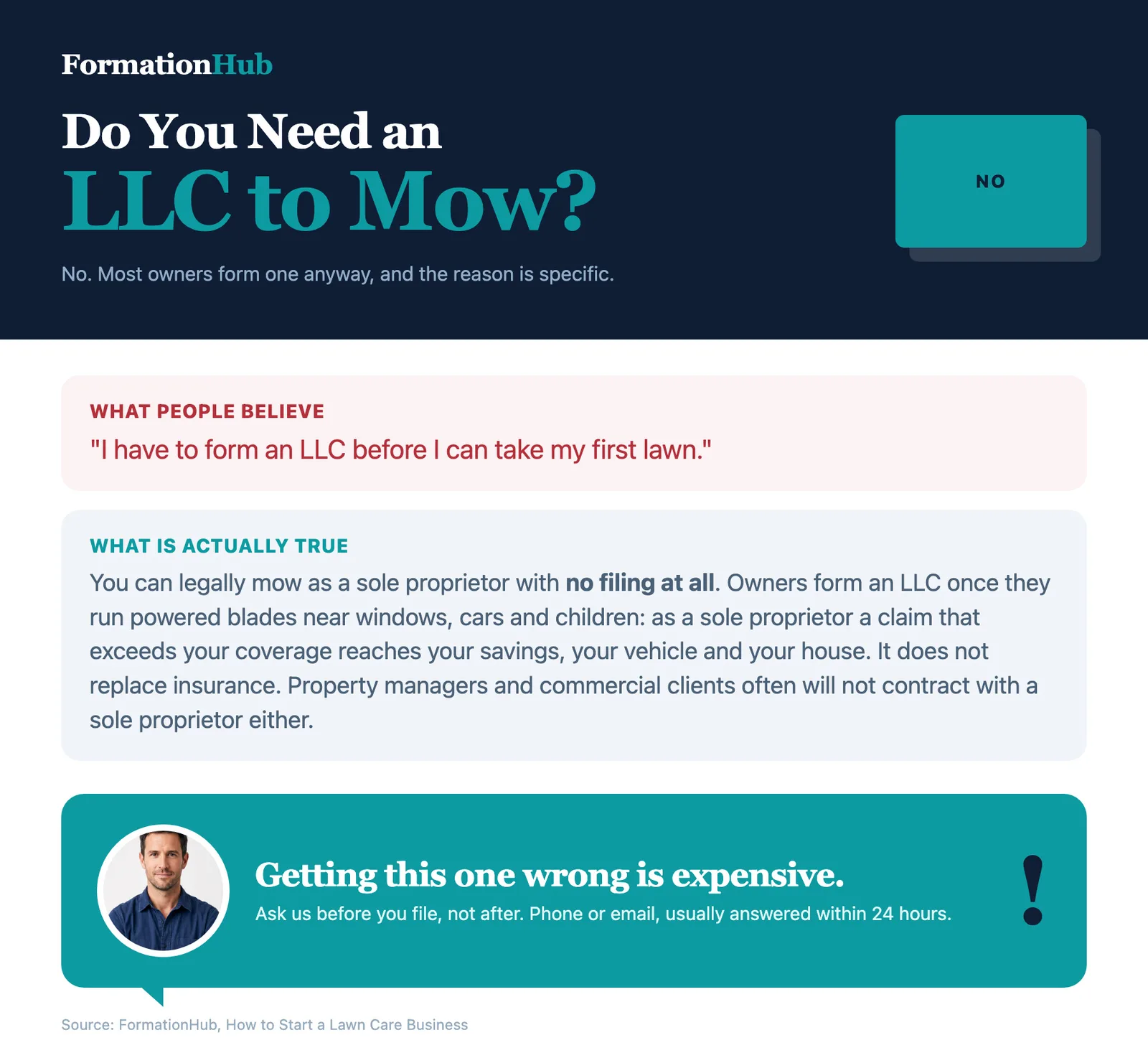
No. You can legally mow lawns as a sole proprietor with no filing at all. Most owners form an LLC anyway once they run powered equipment on other people's property, because a sole proprietorship puts personal assets behind that risk. Filing costs $35 to $500 depending on your state.
As a sole proprietor there is no legal line between you and the business. If a mower throws a rock through a window and the claim exceeds your coverage, it reaches your personal savings, your vehicle and your house. An LLC creates that line. It does not replace insurance, but it keeps a bad afternoon at work from becoming a personal financial event.
This is a higher-risk trade than it looks. You run powered blades near windows, cars, pets and children. That is why an LLC for lawn care business owners is common even among one-person operations. Property managers and commercial clients frequently will not contract with a sole proprietor either, so registering stops being optional once you want work beyond residential lawns.
The tradeoff is real, because some states charge again every year. Weigh that against what you are risking. A complete walkthrough of the formation process covers each step.
How to Register Your Lawn Care Business Legally
Knowing how to start a lawn care business legally is mostly doing six things once.
- Pick and Check the Name. Your state rejects a name already in use, so check availability with the state business registry first. Naming guidance helps if you are stuck on lawn care business names.
- File Your Articles of Organization. This document creates the LLC. It goes to your state filing office, usually the Secretary of State, and this is where the $35 to $500 fee applies.
- Appoint a Registered Agent. Every state requires one: a person or company at a physical in-state address who accepts legal documents during business hours. You can be your own, but your address becomes public record and the role requires being reachable all day. See how registered agent service works.
- Get an EIN. It is free from the IRS and takes minutes online. You need one to hire anyone, and most banks require it. See the EIN application.
- Note Your NAICS Code. Landscaping falls under NAICS 561730. The NAICS code for lawn care business filings appears on taxes, licenses and insurance forms, so look yours up on the Census Bureau site once.
- Open a Business Bank Account. Mixing personal and business money undermines the protection you paid for.
Most states process online filings in a few business days. Federal guidance on choosing a business structure is worth reading.
Licenses, Permits and Insurance
Business Licenses and Permits
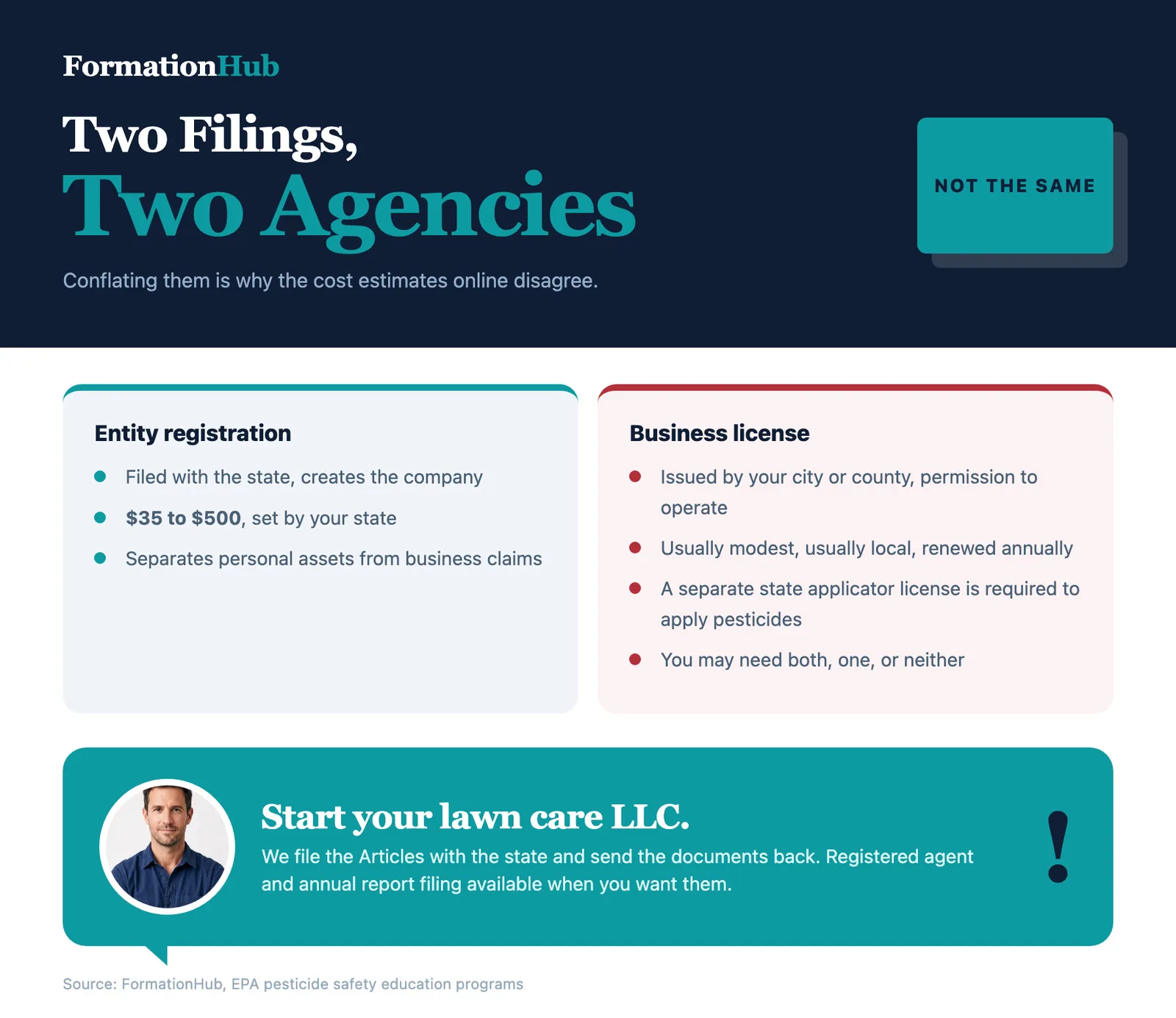
A lawn care business license and your state entity registration are not the same thing, and conflating them is why cost estimates online are unreliable.
The entity filing creates your company at the state level. A business license is permission to operate, usually issued by your city or county and renewed annually. You may need both, one, or neither. Most mowing, trimming and edging requires no specialized trade license.
Applying pesticides or herbicides requires a state applicator license in every state, typically through the state department of agriculture and often requiring an exam. Some states extend the same requirement to commercial fertilizer application. The EPA publishes the pesticide safety education programs by state, so get certified before you sell weed control or fertilization. Some states also require a contractor license once landscaping work passes a dollar threshold. State license guidance is worth reading for your own state.
Coverage You Actually Need
Three policies matter here. General liability insurance for lawn care business owners covers property damage and injury claims from your work: thrown debris, cut irrigation lines, scarred surfaces. It is the difference between a claim and a closure.
Two other policies come up fast. Commercial auto coverage applies once you use a vehicle for work, because personal policies exclude business use. Workers compensation becomes required in most states once you hire anyone.
Lawn care business insurance cost depends on your services, state, vehicle and payroll, so published averages are close to meaningless. Get quotes from several carriers using your real service list.
Lawn Care Business Equipment
You need less than you think to start a lawn care business. The core lawn care business equipment list is a mower, a string trimmer, an edger, a blower, fuel cans, and safety gear including eye and ear protection.
Buy the second tier only when jobs demand it: a bigger mower for larger properties, a trailer once you outgrow a truck bed, and tools like an aerator when you sell those services. Rent anything you use a few times a year.
How to Price Your Services and Get Your First Customers
Pick a pricing model and apply it consistently: a flat rate per property, an hourly rate, a per-square-foot rate for commercial jobs, or a monthly seasonal rate. Calculate your true cost per hour first, including fuel, maintenance, insurance and drive time, then add margin. Underpricing to win early work is the most common mistake in this trade.
Marketing a lawn care business at the start is unglamorous and local. Tell everyone you know. Claim your Google Business Profile, which costs nothing. Post in neighborhood groups. Put your name and number on your vehicle. Ask satisfied clients for referrals and reviews.
Route density beats customer count. Ten lawns on one street earn more per hour than twenty scattered across a county, because unpaid drive time destroys margin.
Is a Lawn Care Business Profitable?
It can be, and the margins are real because overhead is low. The two things that decide it are route density and pricing discipline. The season is the constraint: in most of the country mowing revenue runs spring through fall, so profitable operators bank the summer or sell winter services.
Competition is heavy, because the barrier to entry is a mower. Most people who start a lawn care business compete on price, which is why so many fail in year two. Reliability and quality separate the operators who last.
What Your Lawn Care Business Owes Every Year
This is the cost almost nobody mentions. Registering the company is a one-time fee. Keeping it is not.
| State | Cost to File | Ongoing Every Year |
|---|---|---|
| Montana | $35 | $20 annual report |
| California | $70 | $800 franchise tax |
| Ohio | $99 | No annual report, no franchise tax |
| Florida | $125 | $138.75 annual report |
| Texas | $300 | No annual report, but a franchise tax and Public Information Report |
| Massachusetts | $500 | $500 annual report |
Read those two columns together. California is among the cheapest states to file in and one of the most expensive to stay in, because the $800 franchise tax is due every year regardless of profit. Ohio costs more to start and nothing to maintain. Compare only the filing fee and you draw the wrong conclusion.
Miss these deadlines and states charge penalties, then eventually dissolve the company, removing the liability protection you were paying for. Check the full filing costs by state before you file.
Start Your Lawn Care Business the Right Way
The mowing is the easy part. What people get wrong when they start a lawn care business happens off the mower: the wrong filing, a missed annual report, no insurance. Get the registration right once, keep the filings current, and the business behind the mower looks after itself.
File your LLC with FormationHub and get your paperwork moving.
Disclaimer: FormationHub is not a law firm or an accounting firm, and this article is general information, not legal or tax advice. Filing fees, processing times, and state requirements change. Confirm the current requirements with your state's filing office or the IRS before you file, and talk to a licensed attorney or CPA about your specific situation.
You Might Also Like
- How to Start a Cleaning Business
- Construction LLC
- LLC for Trucking Company
- How Much Does It Cost to Start a Business
- Single Member LLC